Industrial & agriculture automation · Pune, India
From 4–20 mA to the internet.
Your plant is already full of signals — loop currents, contact closures, pulse outputs from a flow meter. They simply have nowhere to go. We build the transmitters, converters, dataloggers and panel HMIs that pull every one of them onto a single RS-485 Modbus trunk and push them to a dashboard you can open from anywhere.
The signal chain
Where every
product sits.
Our catalogue isn't a list — it's a path. Each category solves exactly one hop between the probe in your tank and the number on your screen.
Categories
Everything we build.
Eight product families across water, HVAC, pharma and agriculture — every unit speaks Modbus RTU over RS-485 and carries a documented register map. Pick a category to explore.
Transmitter (24V Power)
Panel-mount meters, 24 V powered
Transmitter (Loop Power)
Loop-powered 2-wire transmitters
Signal Converter
Protocol & media conversion
Scanner / Isolators
Channel scanning & loop isolation
Datalogger
Local logging to SCADA
IOT Gateway
Field data to the cloud
Touch Display Unit
HMI panels & call systems
Customize products
Built to your parameter & enclosure

RO plants & hospital water
Twelve sites.
One screen.
Feed and permeate conductivity, three flows, a UV interlock and membrane service intervals — visible from wherever the service contractor happens to be that morning, not only from the corridor outside the plant room.
How a system goes together
One trunk,
up to 32 devices.
Most plants don't need a new PLC. They need the instruments they already own to be readable from one place. RS-485 does that on two shielded wires — devices daisy-chain along a single trunk, each answers to its own Modbus address, and one master polls them in turn.
Measure at the point
A transmitter turns what the probe sees into a signal the panel can use, with PT100 temperature compensation applied at source rather than corrected later in software.
TransmitterBring old kit onto the bus
Instruments that only output 4–20 mA don't get thrown away. Eight loops land on one converter and appear as Modbus registers alongside everything else.
Signal ConvertersPoll, buffer, send
The datalogger reads each address on a fixed cycle, writes to local storage first, then posts to your endpoint. If the link drops, readings accumulate and go up when it returns.
IoT dataloggerAct on it locally
A dashboard is no use to the operator standing at the skid. Panel HMIs show live values, drive relays and dose pumps, and raise alarms without waiting on the network.
Touch display unitsLocal SCADA software
The plant room,
on one screen.
Local SCADA runs on a Windows PC on the plant network and polls your devices over the serial link — no internet, no subscription, nothing leaving the site. Tap a marker to see what each part does.
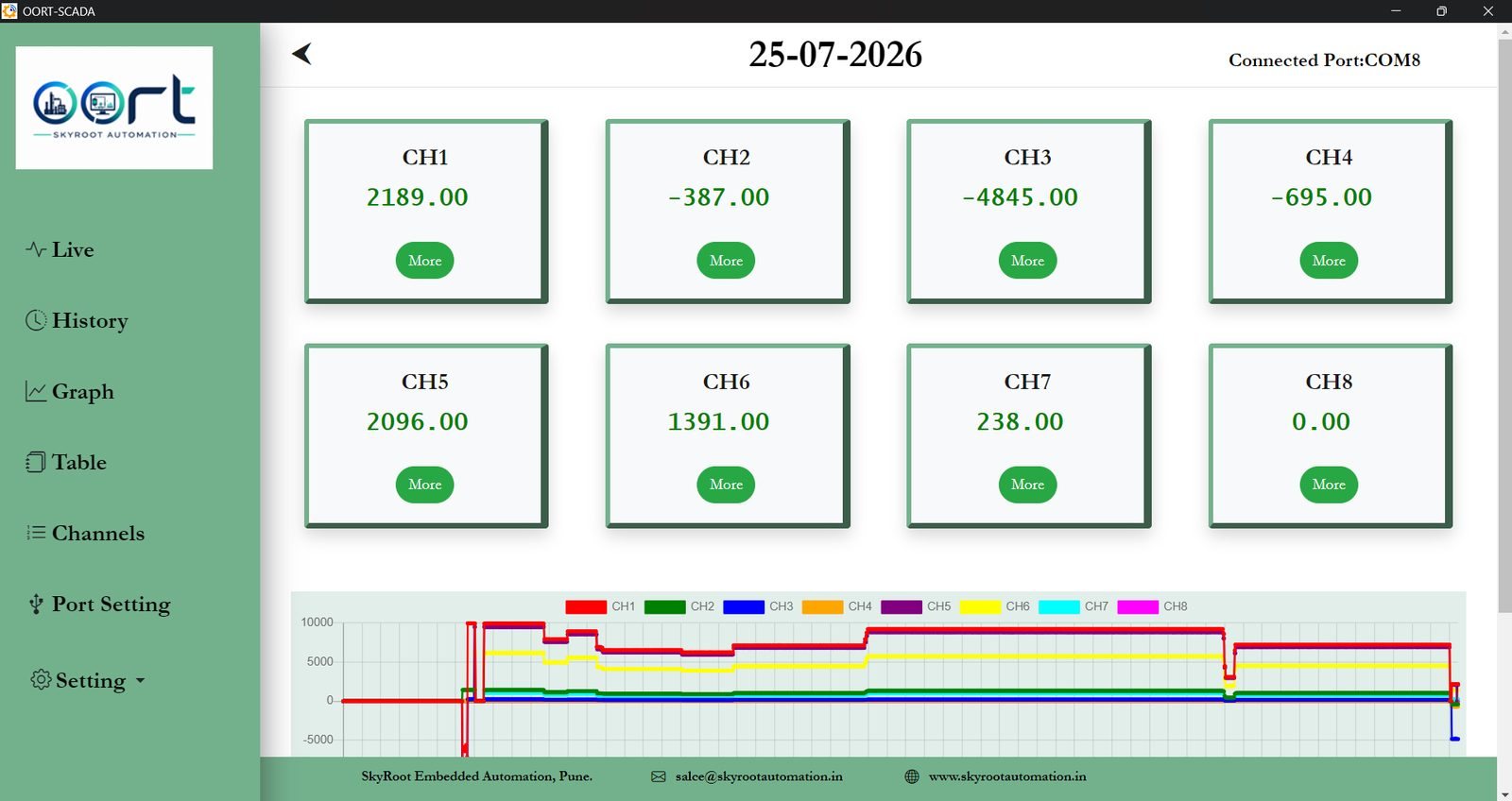
01 · Live, history, graph, table
One sidebar covers the whole job — watch values update live, scroll back through history, plot a trend, or read the raw table. The operator learns one screen, not five.
02 · Eight channel tiles
Every connected channel gets its own tile with the current reading in plain, large type. Open any one for the detail behind it, without losing sight of the rest.
03 · Serial port connection
The header shows the port it is polling and the date it is logging against, so a glance tells you the link is alive — the first thing anyone checks when a number looks wrong.
04 · Multi-channel trend
All eight channels plotted on one time axis, colour-coded to the legend. Overlaying them is how you spot that a dose pump and a conductivity rise are the same event.
05 · Channel & port setup
Name channels, set scaling and choose the port from inside the application. Commissioning is done at the PC in front of you, not in a configuration file.
Live on the bus
What the master
is actually saying.
Modbus RTU isn't magic — it's a short question and a short answer, repeated forever. Here is the same four-device trunk from the diagram above, polling in real time.
Why it survives a real plant
Decisions that
matter at 2 a.m.
Field failures are rarely exotic. They're earth loops, a broken wire nobody noticed for a week, and a network outage during the one shift that mattered.
Galvanic isolation on every analogue output
Plant earth and panel earth are rarely at the same potential, and a VFD in the same cabinet makes it worse. Isolated outputs stop that difference riding into your readings — or your converter.
4 mA means working. 0 mA means broken.
A 4–20 mA loop reads zero at 4 mA, so a cut cable is instantly distinguishable from a genuine zero reading. That single property is why the standard has outlived every replacement proposed for it.
Loop power where cable is expensive
The pH/ORP transmitter takes its supply from the same pair that carries its signal. Across a tank farm or a long effluent channel that halves the cable you pull and the glands you seal.
Log locally, sync later
Dataloggers write to onboard storage before attempting an upload. A 4G outage becomes a gap that backfills, not a hole in your records.
Modbus RTU, not a proprietary bus
Every register is documented and readable by any SCADA, PLC or BMS you already run. You are not locked to us — which is exactly why integrators specify us.
Standard cutouts, DIN-friendly widths
96×96 and 120×100 front bezels, and a 70 mm-wide converter that fits between existing rail-mounted gear. A retrofit shouldn't need a new enclosure.

Retrofit, not replace
Your 4–20 mA instruments stay exactly where they are.
Eight loops land on one isolated converter and appear as Modbus registers beside everything else on the trunk. No rip-out, no new PLC, and no new enclosure — the converter is 70 mm wide and sits between the gear already on your rail.
Analogue to RS-485 Converter · SR-13Where it's running
Water, air, and
everything wet.
The same four building blocks reappear across very different plants. What changes is the parameter, the range, and who needs to see the number.
Effluent & sewage treatment
ETP and STP operators are increasingly expected to show continuous, timestamped data rather than a monthly lab report. Knowing your outlet is drifting out of spec at 3 p.m. is worth far more than discovering it in a notice three weeks later. One analyser handles ten parameters, eight relays and both master and slave RS-485 on the same box.
Typical build
Lab-water: RO, hospital & pharma
From reverse-osmosis skids and hospital water to pharmaceutical purified-water loops. Feed and permeate conductivity, three flows, UV interlock and membrane intervals on one screen — and on a phone for the contractor who services twelve sites. For pharma loops the resistivity meter reads down to 0.01 kΩ·cm with PT100 compensation, logged continuously for a clean audit.
Typical build
HVAC & building management
Humidity and temperature control with a 0–10 V output that drives a steam valve or damper directly, and a BACnet path so the building's existing BMS reads it without an extra gateway box in the ceiling void.
Typical build
Agriculture & hydroponics
Nutrient EC and pH in the feed line, logged across a whole season rather than sampled by hand twice a week. Cellular uplink matters here — polyhouses rarely have structured cabling, and the nearest switch is usually a kilometre away.
Typical build
Vehicles & special machines
Not every controller lives in a panel. The fire vehicle HMI runs off the tender's own supply and shows pump pressures, foam and water level, and engine RPM to a crew wearing gloves — four analogue inputs, six digital outputs and a pulse channel for RPM.
Typical build

Effluent & sewage treatment
The regulator asks for numbers, not memories.
Continuous, timestamped readings from pH, TSS, COD and flow — logged whether or not anyone is standing at the outlet at three in the morning. One analyser covers ten parameters, eight relays, and both master and slave RS-485 on the same box.

Designed, built and supported in Pune
Hardware that lives in the panel.
Not a reseller, not an importer with a sticker. The board is designed here, the firmware is written here, and the person who answers the phone when a meter misbehaves on a Sunday is the person who wrote the code inside it.
SmartSence IoT Cloud Platform
The number,
wherever you are.
Every SkyRoot logger and controller ships ready to talk to SmartSence — our own platform for collecting, charting and alarming on device data. The destination URL is configurable, so if your IT department wants the data on their own server or on AWS instead, point it there. We don't hold your plant hostage.
- Live values and trends per devicepolled on a configurable cycle
- Threshold alarms by SMS and emailso nobody has to be watching the screen
- Historical logs with CSV exportfor the report the auditor actually wants
- Local SCADA optionfor plants that will not put process data on the internet
- Android app on the same datafor the engineer standing at the skid
How we work
From enquiry to
production.
Whether you're buying one meter off the catalogue or commissioning a board, the route is the same.
Enquiry
Send the parameter, the range, the output signal and the mounting. If a catalogue product fits, we say so and quote it — we won't invent a custom job you don't need.
Specification
For custom work we agree the electrical spec first: supply, isolation, channel counts, protocol and enclosure. Everything downstream is cheaper to change at this stage than any other.
Design & prototype
Schematic and layout in Altium, firmware written in-house, panel drawings in EPLAN where the job needs one. You see a working unit before anything goes to volume.
Validation on site
Bench testing tells you the board works. Commissioning on your trunk, against your probes and your earth, tells you the system works. We do both.
Production & support
Small and medium volume assembly, with the register map and documentation handed over so your integrator is never dependent on a phone call to us.
Before you ask
Questions we get
on every call.
Yes. Everything speaks Modbus RTU over RS-485, and the register map is documented, so any PLC, SCADA or BMS that can act as a Modbus master will read it. If you need it on Ethernet instead, the RS-485 to Ethernet converter presents the same data over Modbus TCP, UDP or BACnet.
The datalogger writes every reading to onboard storage before it attempts an upload, so an outage produces a gap that backfills once the link returns rather than a permanent hole. Nothing depends on the connection being up at the moment of the reading.
No. The destination URL is user-configurable — point it at SmartSence, at your own server, or at AWS. For plants that will not put process data on the internet at all, the Local SCADA option keeps everything inside the building.
That's how most of the catalogue started. Send the parameter, the range, the output signal and the enclosure or mounting you need, and we quote the PCB, the firmware and the panel as a single job.
Up to about 1200 m on shielded twisted pair at moderate baud rates, with up to 32 devices on one segment before you need a repeater. It must be daisy-chained rather than star-wired, with a 120 Ω termination resistor at each physical end.
The transmitters use 96×96 mm and 120×100 mm front bezels — the common DIN cutouts on Indian switchgear — and clamp from the rear. The signal converter is 70 mm wide so it sits between existing rail-mounted gear without a new enclosure.
Not sure what
you need yet?
Send us the parameter and the range. We'll tell you which product fits, or whether you'd be better off with something we build to order.